
Where Did Wisconsin’s Moose Go? (And Why Coming Back Was Never Simple)
- Dec 15, 2025
- 2 min read
Once upon a time, moose didn’t need to hide in Wisconsin.
Before European settlement, moose occupied much of the northern half of the state, living in conifer and mixed hardwood forests primarily north of about 44 degrees latitude. For reference, 44° N is not very far north — picture a line running roughly from Green Bay to Marshfield to Eau Claire. Moose were a familiar, if elusive, part of the landscape.
By the mid to late 1800s, that changed.
Overhunting played a major role in the disappearance of moose from Wisconsin. By the early 1900s, they were no longer considered part of the state’s wildlife.
For decades, Wisconsin had no resident moose population.
There were occasional reports of moose sightings in the mid-1900s, but these were believed to be animals wandering in from Michigan or Minnesota rather than evidence of a recovering population. Moose had not returned in any meaningful or sustained way.
That absence eventually raised an obvious question.
Could moose be brought back?
In 1989, the Wisconsin State Legislature directed the Department of Natural Resources to investigate the feasibility of reintroducing several large ungulates, including elk, moose, and caribou. The resulting report, published in 1990, evaluated whether Wisconsin could realistically support these species again.
The conclusion was mixed.
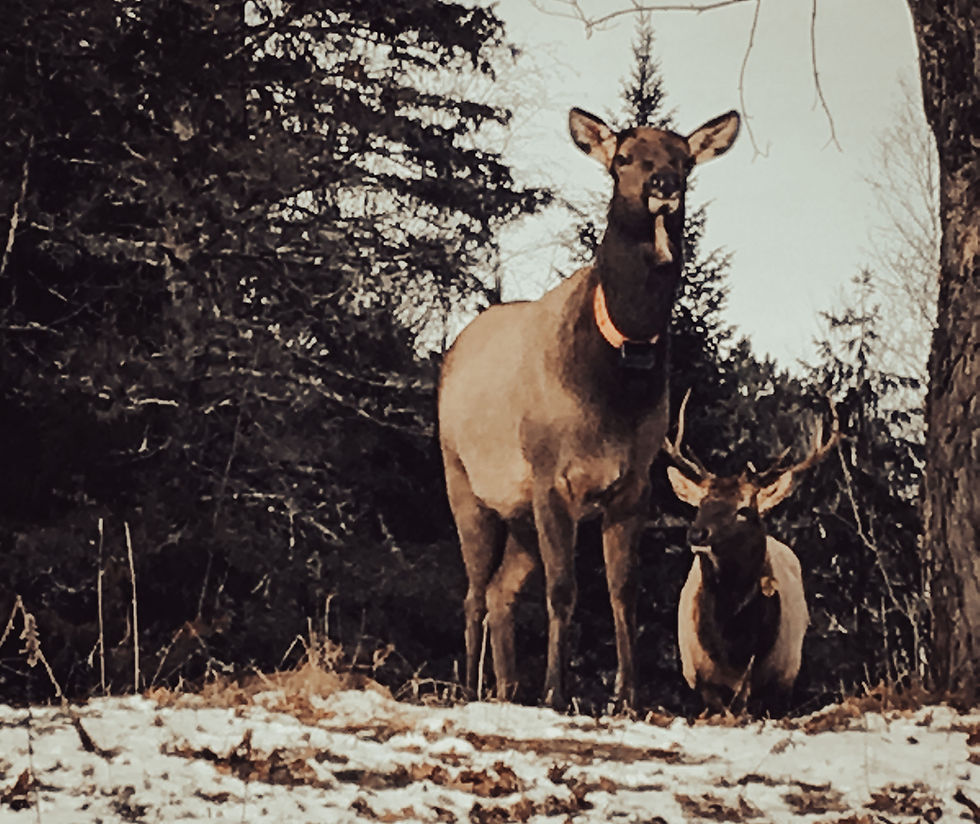
The assessment determined that elk reintroduction could likely succeed, but that moose and caribou would face significant challenges. The report identified several limiting factors, including whether Wisconsin’s landscapes consistently provided the specific mix of habitats moose require, as well as ecological pressures such as high white-tailed deer densities and the presence of brainworm. As a result of that assessment, Wisconsin began reintroducing elk near Clam Lake in 1995, and subsequent releases and management efforts have helped the state’s elk herds grow and persist to the present day.
Moose were therefore not selected for reintroduction in Wisconsin.
But that wasn’t the end of the story.
Moose continued to appear in northern Wisconsin anyway. As Minnesota’s moose population had expanded in the 1960s and a reintroduction effort took place in Michigan’s Upper Peninsula in the mid-1980s, individual moose were crossing into Wisconsin on their own.
Wisconsin didn’t reintroduce moose. Moose reintroduced themselves.
Today, the Wisconsin Department of Natural Resources estimates the state’s moose population at roughly 20 to 40 animals, concentrated in the northern counties. This estimate comes from confirmed sightings voluntarily reported by people who encountered moose, rather than from a systematic survey, so the true number may be higher or lower.
Which leaves Wisconsin with a population that appears small and hard to track, though much about their movements remains unknown.
Next up: why moose are spectacularly bad at being seen.
NOTE: This post draws from Wisconsin DNR records and published wildlife research, including materials from the University of Wisconsin–Stevens Point.
Sources
University of Wisconsin–Stevens Point, Biology Department. Alces alces (Moose): Mammals of Wisconsin.
Wisconsin Department of Natural Resources (2003a). Moose on the Loose!
Parker, L. R. (1990). Feasibility Assessment for the Reintroduction of North American Elk, Moose, and Caribou into Wisconsin.


Comments